-
A clear workplace policy for environments requiring tight‑fitting respiratory protection. This Clean Shaven Policy outlines the requirement for workers to remain clean‑shaven to ensure effective respirator seals when exposed to hazards such as silica, asbestos, lead, and diesel fumes.Includes guidance on fit testing, approved air‑powered respirator alternatives, and compliance requirements to support workplace safety and regulatory obligations. -
Solar Installer SWMS Bundle - NECA | Safety-Compliant & Easily Customizable The Solar Installer SWMS Bundle from NECA is the perfect choice for those looking to ensure compliance and safety in the electrotechnology industry. This bundle includes comprehensive documents on Electrical, Working at Heights, Asbestos, Silica, Overhead Powerlines, Extreme Temperature, Electrical Isolation, Electrical Testing, Verification Testing, Cable Installation, Solar Installation, Batteries, Radio Frequency hazards, General Trade work, Ladders, Scaffolds & Temporary Edge Protection, EWP Restraint and Fall Arrest Equipment and restricted spaces SWMS. Suitable for electrotechnology trades including:
Compliant in all Australian States and New Zealand

What’s Included
This ready-to-use SWMS package features:
- Low Voltage Electrical
- Working at Heights
- Asbestos
- Mobile Plant
- General trade Work
- Ladders
- Scaffolds and Temporary Edge Protection
- Elevated Work Platforms
- Restraint and Fall Arrest Equipment
- Electrical Isolation
- Electrical Testing
- Verification Testing
- Solar Installation
- Batteries
- Style A (Blue): A simple, streamlined version inspired by the Safe Work Australia template, perfect for workers who prefer clear, straightforward safety documents.
- Style B (Tan): A detailed format designed to meet strict compliance checklists, ideal for principal contractors requiring enhanced documentation.
- Simplify compliance with principal contractor requirements.
- Save admin time with editable MS Word templates ready for instant download.
- Provide clear, user-friendly documents to reduce frustration in the workplace.
- Access NECASafe’s comprehensive library of safety documents
- Stay compliant with automatic updates tailored to industry standards
- Create site-specific documents in minutes—no more tedious Cut, Copy, and Paste
-
Temporary Generator Installation Safe Work Method Statement (SWMS) SWMS OverviewThis task involves the installation of a temporary generator to supply power during outages or planned works. Key hazards include electric shock, backfeeding into the network, fuel handling risks, fire, manual handling injuries, and noise exposure. Control measures include isolating and locking out the normal supply, using appropriate changeover switches, earthing the generator correctly, and ensuring proper ventilation. Fuel must be stored and handled safely, with spill kits on hand. PPE includes hearing protection, gloves, and arc-rated clothing. Only qualified electricians are to perform electrical connections. All workers must be trained, inducted, and emergency procedures must be established.
Suitable for electrotechnology trades including:
Compliant in all Australian States and New Zealand

What’s Included
This ready-to-use SWMS package features:
- Understanding NECA SWMS
- JSA SWMS Cover Sheet
- Temporary Generator Installation SWMS – Style A
- Temporary Generator Installation SWMS – Style B
- SWMS Sign off Sheet
- Style A (Blue): A simple, streamlined version inspired by the Safe Work Australia template, perfect for workers who prefer clear, straightforward safety documents.
- Style B (Tan): A detailed format designed to meet strict compliance checklists, ideal for principal contractors requiring enhanced documentation.
- Simplify compliance with principal contractor requirements.
- Save admin time with editable MS Word templates ready for instant download.
- Provide clear, user-friendly documents to reduce frustration in the workplace.
-
Sale!
Crane Borer Operations Safe Work Method Statement (SWMS) SWMS OverviewThe Safe Work Method Statement (SWMS) for Crane Borer Operations outlines the safety procedures and control measures required for the use of truck-mounted crane borers during pole hole excavation, pole installation, and lifting operations in overhead powerline construction. It ensures compliance with Australian Work Health and Safety (WHS) legislation, the Electricity Supply (Safety and Network Management) Regulation, and relevant standards such as AS 2550.1 (Cranes, Hoists and Winches – Safe Use).
Key focus areas include pre-start inspections of the crane borer, confirmation of operator competency and relevant high-risk work licences, and conducting site-specific risk assessments including Dial Before You Dig (DBYD) checks to identify underground services. It also covers traffic and pedestrian management where the borer operates in or near live roadways.
The SWMS highlights the correct setup and stabilisation of the crane borer, ensuring outriggers are deployed on firm ground with pads or dunnage to prevent tipping. It details safe augering techniques, including controlling spoil, maintaining exclusion zones, and avoiding overhead powerlines. When lifting and installing poles, it emphasises rated lifting gear, tag lines, clear communication between operator and ground crew, and spotter supervision to manage swing and load stability.
Electrical safety protocols include maintaining minimum approach distances from live conductors, and implementing network isolation or access permits where required. It also outlines manual handling controls for pole hardware, safe refuelling procedures, and environmental considerations such as spoil disposal and site restoration.
Emergency response procedures include plant failure, pole drop or swing incidents, contact with live conductors, and ground collapse.
By implementing this SWMS, crews can minimise risks such as struck-by injuries, crane overturning, underground service strikes, plant collisions, and electric shock, ensuring crane borer operations are conducted safely, efficiently, and in compliance with all regulatory and network requirements.
Suitable for electrotechnology trades including:
Compliant in all Australian States and New Zealand

What’s Included
This ready-to-use SWMS package features:
- Understanding NECA SWMS
- JSA SWMS Cover Sheet
- Crane Borer Operations SWMS – Style A
- Crane Borer Operations SWMS – Style B
- SWMS Sign off Sheet
- Style A (Blue): A simple, streamlined version inspired by the Safe Work Australia template, perfect for workers who prefer clear, straightforward safety documents.
- Style B (Tan): A detailed format designed to meet strict compliance checklists, ideal for principal contractors requiring enhanced documentation.
- Simplify compliance with principal contractor requirements.
- Save admin time with editable MS Word templates ready for instant download.
- Provide clear, user-friendly documents to reduce frustration in the workplace.
-
Sale!
Cable Jointing, Terminations and Installation of Switchgear Safe Work Method Statement (SWMS) SWMS OverviewThe Safe Work Method Statement (SWMS) for Cable Jointing, Terminations and Installation of Switchgear outlines the safe work practices required for the preparation, jointing, terminating, and testing of low-voltage (LV) and high-voltage (HV) cables, as well as the installation and commissioning of electrical switchgear. It ensures compliance with Australian Work Health and Safety (WHS) legislation, the Electricity Supply (Safety and Network Management) Regulation, and relevant standards including AS/NZS 3000 Wiring Rules, AS/NZS 1429 for cables, and AS 62271 for HV switchgear.
Key focus areas include conducting site-specific risk assessments, verifying network isolation and access permits, and ensuring exclusion zones are established around HV work areas. It details the correct handling and preparation of cables, use of insulated and calibrated tools, and adherence to manufacturer specifications for jointing kits and termination systems.
The SWMS addresses switchgear installation requirements, including correct mechanical anchoring, ensuring proper clearance and ventilation, verifying earthing and bonding arrangements, and performing dielectric and continuity testing before energisation. It also includes safe manual handling of heavy components, use of lifting aids for switchgear and cable drums, and confined/restricted space procedures when working within pits or enclosures.
Electrical safety protocols cover the use of arc-rated PPE, insulated gloves, voltage detectors, and lockout/tagout procedures, as well as maintaining correct sequencing for HV terminations to prevent induced voltages or backfeed. Emergency response plans include arc flash incidents, electric shock, confined space rescue, and first aid requirements.
By following this SWMS, workers can minimise risks such as electric shock, arc flash, tool-related injuries, manual handling strain, confined space hazards, and environmental contamination, ensuring cable jointing, terminations, and switchgear installations are completed safely and to network operator and regulatory standards.
Suitable for electrotechnology trades including:
Compliant in all Australian States and New Zealand

What’s Included
This ready-to-use SWMS package features:
- Understanding NECA SWMS
- JSA SWMS Cover Sheet
- Cable Jointing, Terminations and Installation of Switchgear SWMS – Style A
- Cable Jointing, Terminations and Installation of Switchgear SWMS – Style B
- SWMS Sign off Sheet
- Style A (Blue): A simple, streamlined version inspired by the Safe Work Australia template, perfect for workers who prefer clear, straightforward safety documents.
- Style B (Tan): A detailed format designed to meet strict compliance checklists, ideal for principal contractors requiring enhanced documentation.
- Simplify compliance with principal contractor requirements.
- Save admin time with editable MS Word templates ready for instant download.
- Provide clear, user-friendly documents to reduce frustration in the workplace.
-
Sale!
Land Kiosk Substation Safe Work Method Statement (SWMS) SWMS OverviewThe Safe Work Method Statement (SWMS) for Land Kiosk Substation Construction, Installation and Commissioning provides a structured approach to managing the risks associated with handling, installing, and energising kiosk substations within the electrical distribution network. This includes transport, cranage, positioning, cable terminations, earthing, testing, and commissioning in accordance with Australian Work Health and Safety (WHS) legislation, the Electricity Supply (Safety and Network Management) Regulation, and relevant standards such as AS 2067 (Substations and High Voltage Installations) and AS/NZS 3000 (Wiring Rules).
Key focus areas include conducting site-specific risk assessments, confirming network isolation or access permits, and verifying underground services before excavation or positioning. It details safe use of cranes, lifting beams, and spreader bars to move and install heavy kiosk units, with clear communication protocols between the lifting team and spotters.
The SWMS covers HV and LV electrical safety requirements, including the use of insulated tools, correct termination techniques, earthing and bonding of the kiosk prior to connection, and safe sequencing of works to eliminate step and touch potential. It also addresses confined/restricted space entry procedures where required for underground cable access, as well as traffic and pedestrian management around the site.
Environmental considerations include soil and spill control, safe handling of transformer oil (if applicable), ensuring the plinth is level and structurally compliant, and avoiding damage to adjacent services or vegetation. Emergency response procedures are included for electrical contact incidents, crane/lifting failures, fire, and spill containment.
By implementing this SWMS, workers can minimise risks such as electric shock, arc flash, lifting injuries, plant collisions, manual handling strain, and environmental contamination, ensuring kiosk substations are installed safely, efficiently, and in full compliance with network operator and regulatory requirements.
Suitable for electrotechnology trades including:
Compliant in all Australian States and New Zealand

What’s Included
This ready-to-use SWMS package features:
- Understanding NECA SWMS
- JSA SWMS Cover Sheet
- Land Kiosk Substation SWMS – Style A
- Land Kiosk Substation SWMS – Style B
- SWMS Sign off Sheet
- Style A (Blue): A simple, streamlined version inspired by the Safe Work Australia template, perfect for workers who prefer clear, straightforward safety documents.
- Style B (Tan): A detailed format designed to meet strict compliance checklists, ideal for principal contractors requiring enhanced documentation.
- Simplify compliance with principal contractor requirements.
- Save admin time with editable MS Word templates ready for instant download.
- Provide clear, user-friendly documents to reduce frustration in the workplace.
-
Sale!
Earth Grid Construction and Earthing Safe Work Method Statement (SWMS) SWMS OverviewThe Safe Work Method Statement (SWMS) for Earth Grid Construction and Earthing outlines the procedures and risk controls required when installing and commissioning earthing systems for substations, switchboards, poles, and underground power infrastructure. This includes the installation of earth rods, tapes, and earth grid connections to ensure electrical safety and network compliance. It aligns with Australian Work Health and Safety (WHS) legislation, the Electricity Supply (Safety and Network Management) Regulation, and relevant standards such as AS/NZS 3000 and AS/NZS 4853 (Electrical Hazards on Metallic Structures).
Key focus areas include site risk assessments and the identification of underground services before excavation, ensuring safe trenching practices for buried earthing conductors, and correct mechanical and electrical connection methods (e.g. exothermic welding or bolted clamps). It also covers safe use of hand tools and powered equipment, management of potential step and touch voltages during commissioning, and verification of earth resistance values using approved testing equipment.
The SWMS highlights electrical isolation requirements where connections to existing live infrastructure are required, correct PPE including arc-rated clothing, gloves, and insulated tools, and ensuring appropriate lifting and manual handling practices for earth rods and reels. Environmental considerations such as preventing soil contamination, backfilling trenches correctly, and maintaining site integrity are also included.
By following this SWMS, workers can minimise risks such as electric shock, excavation hazards, manual handling injuries, tool-related injuries, and environmental damage, ensuring earthing systems are constructed safely, effectively, and in compliance with network operator and regulatory requirements.
Suitable for electrotechnology trades including:
Compliant in all Australian States and New Zealand

What’s Included
This ready-to-use SWMS package features:
- Understanding NECA SWMS
- JSA SWMS Cover Sheet
- Earth Grid Construction and Earthing SWMS – Style A
- Earth Grid Construction and Earthing) SWMS – Style B
- SWMS Sign off Sheet
- Style A (Blue): A simple, streamlined version inspired by the Safe Work Australia template, perfect for workers who prefer clear, straightforward safety documents.
- Style B (Tan): A detailed format designed to meet strict compliance checklists, ideal for principal contractors requiring enhanced documentation.
- Simplify compliance with principal contractor requirements.
- Save admin time with editable MS Word templates ready for instant download.
- Provide clear, user-friendly documents to reduce frustration in the workplace.
-
Sale!
Street Light Installation Safe Work Method Statement (SWMS) SWMS OverviewThe Safe Work Method Statement (SWMS) for Street Light Installation outlines the procedures and safety controls required for the installation, replacement, and maintenance of street lighting infrastructure within public roadways, car parks, and pedestrian areas. This includes pole erection, luminaire and bracket installation, underground cable connections, and commissioning. It ensures compliance with Australian Work Health and Safety (WHS) legislation, the Electricity Supply (Safety and Network Management) Regulation, local council requirements, and relevant Australian Standards (e.g. AS/NZS 1158 Lighting for Roads and Public Spaces).
Key focus areas include conducting site-specific risk assessments and traffic management planning, particularly for high-traffic areas. It highlights the safe use of Elevated Work Platforms (EWPs), cranes, and other lifting equipment, as well as the establishment of exclusion zones for pedestrians and vehicles.
The SWMS also addresses electrical safety requirements, including isolation of underground or overhead circuits, confirmation of network permits, and safe handling of live conductors if authorised. It covers correct manual handling and lifting techniques for poles and luminaires, proper anchoring of poles, and inspection of mounting hardware. Environmental controls are incorporated to prevent damage to underground services and protect nearby vegetation or heritage structures.
Emergency response procedures are included for electrical contact incidents, equipment failure, working at height rescues, and traffic-related emergencies.
By following this SWMS, workers can minimise risks such as electric shock, falls from height, plant collisions, traffic hazards, and manual handling injuries, ensuring street lighting installation is completed safely, efficiently, and in full compliance with WHS and network operator requirements.
Suitable for electrotechnology trades including:
Compliant in all Australian States and New Zealand

What’s Included
This ready-to-use SWMS package features:
- Understanding NECA SWMS
- JSA SWMS Cover Sheet
- Street Light Installation SWMS – Style A
- Street Light Installation SWMS – Style B
- SWMS Sign off Sheet
- Style A (Blue): A simple, streamlined version inspired by the Safe Work Australia template, perfect for workers who prefer clear, straightforward safety documents.
- Style B (Tan): A detailed format designed to meet strict compliance checklists, ideal for principal contractors requiring enhanced documentation.
- Simplify compliance with principal contractor requirements.
- Save admin time with editable MS Word templates ready for instant download.
- Provide clear, user-friendly documents to reduce frustration in the workplace.
-
Overhead Powerline Construction Safe Work Method Statement (SWMS) SWMS OverviewThe Safe Work Method Statement (SWMS) for Overhead Powerline Construction outlines the safety procedures and risk controls required for the installation, upgrade, and maintenance of overhead electrical infrastructure within the distribution network. This includes pole erection, cross-arm and insulator installation, stringing and tensioning conductors, and decommissioning old assets. It ensures compliance with Australian Work Health and Safety (WHS) legislation, the Electricity Supply (Safety and Network Management) Regulation, network operator requirements, and relevant Australian Standards (e.g. AS/NZS 3000, AS/NZS 7000).
Key focus areas include site-specific risk assessments, identification of live electrical assets, and confirmation of network isolation permits or authorisations when required. It highlights safe use of Elevated Work Platforms (EWPs), ladders, and climbing equipment, correct rigging and lifting techniques for poles and hardware, and maintaining minimum approach distances and exclusion zones near live conductors.
This SWMS also addresses traffic and pedestrian management, safe operation of cranes and plant around the worksite, and ensuring all lifting and tensioning equipment is certified and inspected. It incorporates the use of personal protective equipment (PPE) such as insulating gloves, arc-rated clothing, and fall arrest harnesses. Emergency response procedures cover pole failure, conductor drops, electrical contact incidents, and rescue from heights.
By implementing this SWMS, crews can minimise risks such as electric shock, falls from height, falling objects, plant collisions, and conductor contact incidents, ensuring overhead powerline construction is carried out safely, efficiently, and in compliance with WHS and network operator requirements.
Suitable for electrotechnology trades including:
Compliant in all Australian States and New Zealand

What’s Included
This ready-to-use SWMS package features:
- Understanding NECA SWMS
- JSA SWMS Cover Sheet
- Overhead Powerline Construction SWMS – Style A
- Overhead Powerline Construction SWMS – Style B
- SWMS Sign off Sheet
- Style A (Blue): A simple, streamlined version inspired by the Safe Work Australia template, perfect for workers who prefer clear, straightforward safety documents.
- Style B (Tan): A detailed format designed to meet strict compliance checklists, ideal for principal contractors requiring enhanced documentation.
- Simplify compliance with principal contractor requirements.
- Save admin time with editable MS Word templates ready for instant download.
- Provide clear, user-friendly documents to reduce frustration in the workplace.
-
Painting Safe Work Method Statement (SWMS) SWMS OverviewThe Safe Work Method Statement (SWMS) for Painting Works outlines the safety procedures and risk controls required for surface preparation, application of paints, sealants, and coatings on residential, commercial, and industrial sites in Australia. It ensures compliance with Australian Work Health and Safety (WHS) legislation, the Managing Risks of Hazardous Chemicals in the Workplace Code of Practice, and relevant Australian Standards for paint application.
Key focus areas include conducting a site-specific risk assessment to identify hazards such as working at heights, exposure to fumes and vapours, and potential ignition sources when using flammable products. It highlights the importance of correct surface preparation techniques, safe use of ladders, scaffolds, or elevated work platforms, and ensuring adequate ventilation when working indoors.
This SWMS also addresses the safe storage, handling, and disposal of paints, solvents, and thinners; proper use of personal protective equipment (PPE) including respirators, gloves, coveralls, and eye protection; and implementing spill containment measures to prevent environmental contamination. Emergency procedures for fire, chemical exposure, or falls are also included.
By implementing this SWMS, painters can minimise the risks of falls, chemical exposure, fire hazards, and manual handling injuries, ensuring painting works are completed safely, efficiently, and in compliance with WHS requirements.
Suitable for electrotechnology trades including:
Compliant in all Australian States and New Zealand

What’s Included
This ready-to-use SWMS package features:
- Understanding NECA SWMS
- JSA SWMS Cover Sheet
- Painting SWMS – Style A
- Painting SWMS – Style B
- SWMS Sign off Sheet
- Style A (Blue): A simple, streamlined version inspired by the Safe Work Australia template, perfect for workers who prefer clear, straightforward safety documents.
- Style B (Tan): A detailed format designed to meet strict compliance checklists, ideal for principal contractors requiring enhanced documentation.
- Simplify compliance with principal contractor requirements.
- Save admin time with editable MS Word templates ready for instant download.
- Provide clear, user-friendly documents to reduce frustration in the workplace.
-
Vehicle Loading Crane (VLC) Safe Work Method Statement (SWMS) SWMS OverviewThe Safe Work Method Statement (SWMS) for Vehicle Loading Cranes (VLCs) details the procedures and control measures required to safely load, unload, and position materials using truck-mounted cranes on residential, commercial, civil, and industrial sites in Australia. It ensures compliance with Australian Work Health and Safety (WHS) legislation, the Managing Risks of Plant in the Workplace Code of Practice, and relevant Australian Standards (e.g. AS 2550.11 & AS 1418).
Key focus areas include conducting a site-specific risk assessment to identify ground stability, overhead obstructions, and exclusion zones before crane operation. It highlights the need for pre-operational inspections of the crane, outriggers, lifting gear, and safety devices, as well as ensuring only trained, licensed, and competent personnel operate the VLC.
This SWMS also addresses safe lifting practices such as using certified lifting slings, maintaining clear communication between the operator and dogman/spotter, and ensuring loads are within the crane’s rated capacity. It incorporates traffic and pedestrian management around the loading area, proper load securing methods, and emergency procedures for equipment failure, dropped loads, or tip-overs.
By implementing this SWMS, workers can minimise the risks of crane instability, collisions, falling loads, and equipment malfunctions, ensuring vehicle loading operations are carried out safely, efficiently, and in full compliance with WHS requirements.
Suitable for electrotechnology trades including:
Compliant in all Australian States and New Zealand

What’s Included
This ready-to-use SWMS package features:
- Understanding NECA SWMS
- JSA SWMS Cover Sheet
- Vehicle Loading Crane (VLC) SWMS – Style A
- Vehicle Loading Crane (VLC) SWMS – Style B
- SWMS Sign off Sheet
- Style A (Blue): A simple, streamlined version inspired by the Safe Work Australia template, perfect for workers who prefer clear, straightforward safety documents.
- Style B (Tan): A detailed format designed to meet strict compliance checklists, ideal for principal contractors requiring enhanced documentation.
- Simplify compliance with principal contractor requirements.
- Save admin time with editable MS Word templates ready for instant download.
- Provide clear, user-friendly documents to reduce frustration in the workplace.
-
Sale!
High Voltage Testing Safe Work Method Statement (SWMS) SWMS OverviewThe Safe Work Method Statement (SWMS) for High Voltage (HV) Testing outlines the procedures and safety controls required when performing HV insulation resistance, pressure (HiPot), continuity, phase rotation, and commissioning tests on cables, transformers, switchgear, and other high-voltage electrical assets. This SWMS aligns with Australian Work Health and Safety (WHS) legislation, the Electricity Supply (Safety and Network Management) Regulation, and relevant standards including AS 62271 (HV Switchgear) and AS/NZS 3000 Wiring Rules.
Key focus areas include conducting a site-specific risk assessment prior to testing, verifying network isolation permits, and establishing clear exclusion zones around the test area with warning signs, barriers, and lockout/tagout devices. It details the correct setup, calibration, and operation of HV test equipment, as well as the safe discharge of residual energy after testing.
The SWMS highlights the use of arc-rated PPE, insulated gloves, face shields, voltage detectors, and earthing sticks to prevent step-and-touch potentials. It includes requirements for ensuring all personnel remain at a safe distance during energisation, clear communication protocols between the test operator and the safety observer, and the use of a permit-to-test process where required.
Environmental and equipment considerations include keeping the test area dry and clear of conductive debris, maintaining safe access and egress, and ensuring test leads are in good condition. Emergency response procedures are provided for electric shock, arc flash, and equipment failure incidents, including immediate isolation, rescue, and first aid requirements.
By implementing this SWMS, workers can minimise risks such as electric shock, arc flash, induced voltage hazards, tripping over test leads, and equipment malfunction, ensuring HV testing is carried out safely, accurately, and in compliance with regulatory and network requirements.
Suitable for electrotechnology trades including:
Compliant in all Australian States and New Zealand

What’s Included
This ready-to-use SWMS package features:
- Understanding NECA SWMS
- JSA SWMS Cover Sheet
- High Voltage Testing SWMS – Style A
- High Voltage Testing SWMS – Style B
- SWMS Sign off Sheet
- Style A (Blue): A simple, streamlined version inspired by the Safe Work Australia template, perfect for workers who prefer clear, straightforward safety documents.
- Style B (Tan): A detailed format designed to meet strict compliance checklists, ideal for principal contractors requiring enhanced documentation.
- Simplify compliance with principal contractor requirements.
- Save admin time with editable MS Word templates ready for instant download.
- Provide clear, user-friendly documents to reduce frustration in the workplace.
-
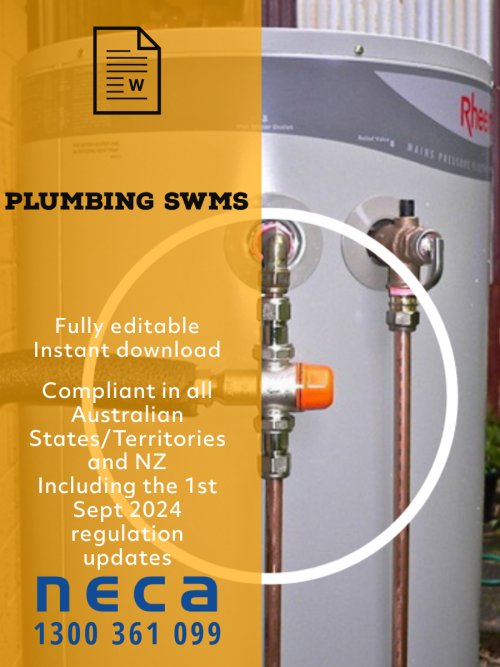
Plumbing Safe Work Method Statement (SWMS) SWMS OverviewThe Safe Work Method Statement (SWMS) for Plumbing Works provides a structured approach to managing health and safety risks associated with the installation, maintenance, and repair of plumbing systems on residential, commercial, and industrial sites in Australia. It ensures compliance with Australian Work Health and Safety (WHS) legislation, the Plumbing Code of Australia, and relevant industry standards.
Key focus areas include conducting a site-specific risk assessment to identify underground and overhead services, isolating water, gas, and electrical supplies before work, and implementing safe manual handling techniques for pipes, fittings, and tools. It highlights the safe use of hand and power tools, working at heights on roofs or in ceiling spaces, and ensuring proper access and ventilation when working in confined or restricted spaces such as subfloors or service pits.
This SWMS also addresses the handling and disposal of hazardous materials such as lead, asbestos, or contaminated water, as well as implementing appropriate personal protective equipment (PPE) including gloves, eye protection, respiratory protection, and hearing protection. Emergency procedures for gas leaks, flooding, or exposure to hazardous substances are also included.
By following this SWMS, plumbers can minimise the risks of slips, trips, falls, exposure to biological and chemical hazards, service strikes, and equipment-related injuries, ensuring all plumbing works are carried out safely, efficiently, and in compliance with WHS requirements.
Suitable for electrotechnology trades including:
Compliant in all Australian States and New Zealand

What’s Included
This ready-to-use SWMS package features:
- Understanding NECA SWMS
- JSA SWMS Cover Sheet
- Plumbing SWMS – Style A
- Plumbing SWMS – Style B
- SWMS Sign off Sheet
- Style A (Blue): A simple, streamlined version inspired by the Safe Work Australia template, perfect for workers who prefer clear, straightforward safety documents.
- Style B (Tan): A detailed format designed to meet strict compliance checklists, ideal for principal contractors requiring enhanced documentation.
- Simplify compliance with principal contractor requirements.
- Save admin time with editable MS Word templates ready for instant download.
- Provide clear, user-friendly documents to reduce frustration in the workplace.
-
- Instant Download in MS Word format
- Fully Editable
Compliant in all Australian States and New Zealand

This product includes the following documents:
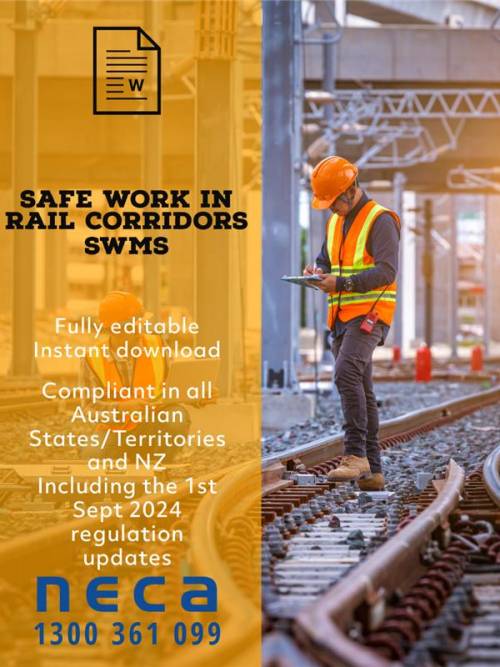
- Safe Work in the Rail Corridor SWMS
- Job Safety Analysis / SWMS Cover Sheet
- Safe Work Method Statement Letter
-
Silica Safe Work Method Statement (SWMS) SWMS OverviewThe Silica Safe Work Method Statement (SWMS) is an essential resource for businesses in the electrotechnology industry, providing clear and actionable guidelines for managing tasks involving Respirable Crystalline Silica (RCS). Whether it’s drilling, cutting, chipping, or chasing materials containing silica, this document ensures workplace safety and compliance. Designed to help manage silica dust exposure and meet occupational health and safety regulations, the Silica SWMS outlines critical safety measures for both low and high-risk tasks.
Built on industry best practices, the Silica SWMS includes procedures for effective dust control, risk assessments, and safe work methods, equipping businesses with tools to confidently address silica hazards. It supports organisations in adhering to regulatory requirements, such as those outlined by Safe Work Australia, while promoting efficiency and safety on-site.
For businesses in Australia (besides Victoria and ACT), it is recommended you purchase the Silica Compliance Document Pack & SWMS. This product provides access to the Silica SWMS, Silica Risk Assessment (to determine if the processing of a CSS is high risk), and the Silicosis Health Monitoring Assessment Form—ensuring you have the complete tools for maintaining compliance and safety.
Adopting the Silica SWMS helps businesses protect workers from silica-related illnesses, maintain compliance with workplace health and safety laws, and foster a proactive safety culture. This comprehensive silica dust management resource demonstrates your commitment to employee safety, risk mitigation, and maintaining a legally compliant and safe work environment.
Suitable for electrotechnology trades including:
Compliant in all Australian States and New Zealand

What’s Included
This ready-to-use SWMS package features:
- Understanding NECA SWMS
- JSA SWMS Cover Sheet
- Silica SWMS – Style A
- Silica SWMS – Style B
- SWMS Sign Off Sheet
- Style A (Blue): A simple, streamlined version inspired by the Safe Work Australia template, perfect for workers who prefer clear, straightforward safety documents.
- Style B (Tan): A detailed format designed to meet strict compliance checklists, ideal for principal contractors requiring enhanced documentation.
- Simplify compliance with principal contractor requirements.
- Save admin time with editable MS Word templates ready for instant download.
- Provide clear, user-friendly documents to reduce frustration in the workplace.
-
ASP Level 1 Safe Work Method Statement (SWMS) SWMS OverviewThe ASP Level 1 Safe Work Method Statement (SWMS) Bundle provides a comprehensive set of documents outlining the safe systems of work for Accredited Service Providers undertaking Level 1 electrical construction tasks. These tasks primarily relate to the construction and installation of network infrastructure before it is energised, including high-risk construction activities.
Suitable for electrotechnology trades
Compliant in all Australian States and New Zealand

What’s Included
This ready-to-use SWMS package features:
- Site Assessment and Set Up for ASP
- Underground Powerline Construction
- Overhead Powerline Construction
- Street Light Installation
- Earth Grid Construction and Earthing
- Land Kiosk Substation
- Cable Jointing and Installation of Switchgear
- High Voltage Testing
- Crane Borer Operations
- Style A (Blue): A simple, streamlined version inspired by the Safe Work Australia template, perfect for workers who prefer clear, straightforward safety documents.
- Style B (Tan): A detailed format designed to meet strict compliance checklists, ideal for principal contractors requiring enhanced documentation.
- Simplify compliance with principal contractor requirements.
- Save admin time with editable MS Word templates ready for instant download.
- Provide clear, user-friendly documents to reduce frustration in the workplace.
- Access NECASafe’s comprehensive library of safety documents
- Stay compliant with automatic updates tailored to industry standards
- Create site-specific documents in minutes—no more tedious Cut, Copy, and Paste
-
Sale!
- Instant Download in MS Word format
- Fully Editable
Compliant in all Australian States and New Zealand

This product includes the following documents:
- Certificate of Periodic Verification (based on AS/NZS 3019:2007 Electrical installations - parodic verification)
- Electrical Installation Testing Record Sheet
This product is free along with hundreds of other safety documents with your membership.
Login to NECA’s Technical Knowledge Base to access this product free of charge
-
An “Inspection and Test Plan” (ITP) might also be called a “Quality Inspection Plan”. Inspection and Test Plans set out critical control points or ‘hold points’ at various stages within a process. Each control point is a scheduled inspection or verification activity where you will make sure that things are progressing as they should be. Inspection and Test Plans are often used as a way to satisfy the requirements of the ISO 9001 standard related to control of production and service provision.- Instant Download in MS Word format
- Fully Editable
Compliant in all Australian States and New Zealand

Activity –
- Pre-Start Safety Documents and SWMS
- Material Unloading, job site storage, and delivery to the installation area.
- Drawing and specification study.
- Layout, measuring and marking the installation location.
- Tool acquisition and return to storage.
- Setup and removal of jacks, winches and cable pullers
- Installation and dressing of cables
- Testing and commissioning of cables for continuity
- Clean up of waste and excess materials
-
An “Inspection and Test Plan” (ITP) might also be called a “Quality Inspection Plan”. Inspection and Test Plans set out critical control points or ‘hold points’ at various stages within a process. Each control point is a scheduled inspection or verification activity where you will make sure that things are progressing as they should be. Inspection and Test Plans are often used as a way to satisfy the requirements of the ISO 9001 standard related to control of production and service provision.- Instant Download in MS Word format
- Fully Editable
Compliant in all Australian States and New Zealand

This product includes:
- Quality Management Plan
- Conduit ITP
- Ladder Tray and Ducts ITP
- Cables and Accessories ITP
- Switchboards and Motor Control ITP
- Light Fittings ITP
- Earthing Systems ITP
- Communications ITP
- Electrical Equipment Register
- Electrical Installation Testing Record Sheet
- Residual Current Device (RCD) Test Record
-
An “Inspection and Test Plan” (ITP) might also be called a “Quality Inspection Plan”. Inspection and Test Plans set out critical control points or ‘hold points’ at various stages within a process. Each control point is a scheduled inspection or verification activity where you will make sure that things are progressing as they should be. Inspection and Test Plans are often used as a way to satisfy the requirements of the ISO 9001 standard related to control of production and service provision.- Instant Download in MS Word format
- Fully Editable
Compliant in all Australian States and New Zealand

Activity –
- Pre-Start Safety Documents and SWMS
- Material Unloading, job site storage, and delivery to the installation area.
- Drawing and specification study.
- Layout, measuring and marking the installation location.
- Tool acquisition and return to storage.
- Setup and removal of jacks, winches and cable pullers
- Installation and dressing of cables
- Testing and commissioning of cables for continuity
- Clean up of waste and excess materials
-
An “Inspection and Test Plan” (ITP) might also be called a “Quality Inspection Plan”. Inspection and Test Plans set out critical control points or ‘hold points’ at various stages within a process. Each control point is a scheduled inspection or verification activity where you will make sure that things are progressing as they should be. Inspection and Test Plans are often used as a way to satisfy the requirements of the ISO 9001 standard related to control of production and service provision.- Instant Download in MS Word format
- Fully Editable
Compliant in all Australian States and New Zealand

Activity –
- Pre-Start Safety Documents and SWMS
- Material Unloading, job site storage, and delivery to the installation area.
- Drawing and specification study.
- Layout, measuring and marking the installation location.
- Tool acquisition and return to storage.
- Installation of earthing system equipment
- Earthing system clamps and terminations
- Clean up of waste and excess materials
-
An “Inspection and Test Plan” (ITP) might also be called a “Quality Inspection Plan”. Inspection and Test Plans set out critical control points or ‘hold points’ at various stages within a process. Each control point is a scheduled inspection or verification activity where you will make sure that things are progressing as they should be. Inspection and Test Plans are often used as a way to satisfy the requirements of the ISO 9001 standard related to control of production and service provision.- Instant Download in MS Word format
- Fully Editable
Compliant in all Australian States and New Zealand

Activity –
- Pre-Start Safety Documents and SWMS
- Material Unloading, job site storage, and delivery to the installation area.
- Drawing and specification study.
- Layout, measuring and marking the installation location.
- Tool acquisition and return to storage.
- Unpacking and assembly of luminaires, Inspection for any delivery damage
- Installation of luminaires complete with lamps, tubes, covers and lenses. Termination of subcircuit cabling to luminaires.
- Clean up of waste and excess materials
-
Electrical Switchboards, Motor Controls & Accessories An “Inspection and Test Plan” (ITP) might also be called a “Quality Inspection Plan”. Inspection and Test Plans set out critical control points or ‘hold points’ at various stages within a process. Each control point is a scheduled inspection or verification activity where you will make sure that things are progressing as they should be. Inspection and Test Plans are often used as a way to satisfy the requirements of the ISO 9001 standard related to control of production and service provision.- Instant Download in MS Word format
- Fully Editable
Compliant in all Australian States and New Zealand

Activity –
- Pre-Start Safety Documents and SWMS
- Material Unloading, job site storage, and delivery to the installation area
- Drawing and specification study
- Layout, measuring and marking the installation location
- Tool acquisition and return to storage
- Unpacking of equipment. Inspection for any delivery damage
- Installation of equipment to final location
- Testing and commissioning of Switchgear and control gear
- Clean up of waste and excess materials
-
An “Inspection and Test Plan” (ITP) might also be called a “Quality Inspection Plan”. Inspection and Test Plans set out critical control points or ‘hold points’ at various stages within a process. Each control point is a scheduled inspection or verification activity where you will make sure that things are progressing as they should be. Inspection and Test Plans are often used as a way to satisfy the requirements of the ISO 9001 standard related to control of production and service provision.- Instant Download in MS Word format
- Fully Editable
Compliant in all Australian States and New Zealand

Activity –
- Pre-Start Safety Documents and SWMS
- Material Unloading, job site storage, and delivery to the installation area.
- Drawing and specification study.
- Layout, measuring and marking the installation location.
- Tool acquisition and return to storage.
- Setup and removal of jacks, winches and cable pullers
- Installation and dressing of cables
- Testing and commissioning of cables for continuity
- Clean up of waste and excess materials
-
Ladders, Ladder Trays, Trays, Ducts, Strut, Brackets and Associated Fittings An "Inspection and Test Plan" (ITP) might also be called a "Quality Inspection Plan". Inspection and Test Plans set out critical control points or 'hold points' at various stages within a process. Each control point is a scheduled inspection or verification activity where you will make sure that things are progressing as they should be. Inspection and Test Plans are often used as a way to satisfy the requirements of the ISO 9001 standard related to control of production and service provision.- Instant Download in MS Word format
- Fully Editable
Compliant in all Australian States and New Zealand

Activity -
- Pre-Start Safety Documents and SWMS
- Material Unloading, job site storage, and delivery to the installation area.
- Drawing and specification study.
- Layout, measuring and marking the installation location.
- Tool acquisition and return to storage.
- Measuring, cutting and handling of materials.
- Installation of cable support systems, including strut brackets
- Clean up of waste and excess materials.
-
Conduits, Conduit Fittings, Civil and Underground Items An "Inspection and Test Plan" (ITP) might also be called a "Quality Inspection Plan". Inspection and Test Plans set out critical control points or 'hold points' at various stages within a process. Each control point is a scheduled inspection or verification activity where you will make sure that things are progressing as they should be. Inspection and Test Plans are often used as a way to satisfy the requirements of the ISO 9001 standard related to control of production and service provision.- Instant Download in MS Word format
- Fully Editable
Compliant in all Australian States and New Zealand

Activity -
- Pre-Start Safety Documents and SWMS.
- Material Unloading, job site storage, and delivery to the installation area.
- Drawing and specification study.
- Layout, measuring and marking the installation location.
- Tool acquisition and return to storage.
- Measuring, cutting, threading (where required) and handling of conduit.
- Installation of conduits and associated saddles (complete with fixings).
- Clean up of waste and excess materials.
-
COVID-19 & Infectious Diseases Safe Work Method Statement (SWMS) SWMS Overview The COVID-19 & Infectious Diseases Safe Work Method Statement (SWMS) is tailored for the electrotechnology industry, offering detailed guidance on managing workplace risks related to COVID-19 and other infectious diseases. This SWMS outlines key strategies such as preventing disease transmission, maintaining health records, and meeting mandatory reporting protocols. Adopting this SWMS enhances workplace safety, ensures compliance, and protects your team from infectious hazards. Suitable for electrotechnology trades including:
Compliant in all Australian States and New Zealand

What’s Included
This ready-to-use SWMS package features:
- Understanding NECA SWMS
- JSA SWMS Cover Sheet
- COVID-19 & Other Infectious Diseases SWMS – Style A
- COVID-19 & Other Infectious Diseases SWMS – Style B
- SWMS Sign Off Sheet
- Style A (Blue): A simple, streamlined version inspired by the Safe Work Australia template, perfect for workers who prefer clear, straightforward safety documents.
- Style B (Tan): A detailed format designed to meet strict compliance checklists, ideal for principal contractors requiring enhanced documentation.
- Simplify compliance with principal contractor requirements.
- Save admin time with editable MS Word templates ready for instant download.
- Provide clear, user-friendly documents to reduce frustration in the workplace.
Get this product free with your membership!
Download the SWMS package along with hundreds of other valuable resources, including policies, procedures, toolbox talks, and more, all available through NECA’s Member Knowledge Base.
Take Action:
-
ASP Level 2 Safe Work Method Statement (SWMS) SWMS OverviewThe ASP Level 2 SWMS Bundle is a comprehensive collection of Safe Work Method Statements specifically developed to support electrical contractors and technicians authorised under the NSW Accredited Service Provider (ASP) Scheme, primarily Level 2 (Category A and B). This bundle ensures alignment with legislative requirements under the NSW Electricity Supply (Safety and Network Management) Regulation 2014, Work Health and Safety Act 2011, and WHS Regulation 2017.
Each SWMS in the bundle outlines the high-risk construction activities, associated hazards, risk controls, and safe work procedures related to Level 2 ASP work.
Suitable for electrotechnology trades
Compliant in all Australian States and New Zealand

What’s Included
This ready-to-use SWMS package features:
- Site Assessment and Set Up for ASP
- Prove De-Energised
- Remove Service Fuse Carriers
- Reinstate Service and Energise Installation
- Replacement of Service Fuse Bases SWMS
- Disconnection of Consumer Mains at POA
- Reconnection of Consumer Mains at POA
- Installation of Underground Service Mains SWMS
- Connection of Underground Service Mains SWMS
- Disconnection of Service Mains SWMS
- Installation of Overhead Service Mains SWMS
- Installation of Metering Equipment SWMS
- Removal of Metering Equipment SWMS
- Installation of Metering Equipment on ACM Meter Panels SWMS
- Safe Work Method Statement Letter
- Style A (Blue): A simple, streamlined version inspired by the Safe Work Australia template, perfect for workers who prefer clear, straightforward safety documents.
- Style B (Tan): A detailed format designed to meet strict compliance checklists, ideal for principal contractors requiring enhanced documentation.
- Simplify compliance with principal contractor requirements.
- Save admin time with editable MS Word templates ready for instant download.
- Provide clear, user-friendly documents to reduce frustration in the workplace.
- Access NECASafe’s comprehensive library of safety documents
- Stay compliant with automatic updates tailored to industry standards
- Create site-specific documents in minutes—no more tedious Cut, Copy, and Paste
-
Installation of Metering Equipment on ACM (Asbestos-Containing Material) Meter Panels Safe Work Method Statement (SWMS) SWMS OverviewThis task involves installing metering equipment on meter panels that contain or may contain asbestos. Hazards include asbestos exposure, electric shock, and arc flash. Control measures include assuming panels contain asbestos unless tested, avoiding drilling or disturbing the panel, wearing appropriate PPE (P2 mask, disposable coveralls, gloves), isolating and testing circuits, and using wet methods or HEPA vacuums to control dust. Only trained and licensed personnel are to perform the work. All asbestos waste must be correctly bagged and disposed of. Emergency procedures and inductions are required.
Suitable for electrotechnology trades including:
Compliant in all Australian States and New Zealand

What’s Included
This ready-to-use SWMS package features:
- Understanding NECA SWMS
- JSA SWMS Cover Sheet
- Installation of Metering Equipment on ACM (Asbestos-Containing Material) Meter Panels SWMS – Style A
- Installation of Metering Equipment on ACM (Asbestos-Containing Material) Meter Panels SWMS – Style B
- SWMS Sign off Sheet
- Style A (Blue): A simple, streamlined version inspired by the Safe Work Australia template, perfect for workers who prefer clear, straightforward safety documents.
- Style B (Tan): A detailed format designed to meet strict compliance checklists, ideal for principal contractors requiring enhanced documentation.
- Simplify compliance with principal contractor requirements.
- Save admin time with editable MS Word templates ready for instant download.
- Provide clear, user-friendly documents to reduce frustration in the workplace.
-
Removal of Metering Equipment Safe Work Method Statement (SWMS) SWMS OverviewThis task involves the safe removal of electrical metering equipment from the point of supply. Key hazards include electric shock, arc flash, incorrect isolation, and exposure to asbestos-containing meter panels. Control measures include isolating and testing for dead, applying lockout/tagout procedures, using insulated tools and arc-rated PPE, and following network provider disconnection protocols. If asbestos is suspected, appropriate precautions must be taken, including use of P2 masks and avoiding disturbance. Only licensed electricians may carry out the work. All personnel must be trained, inducted, and emergency procedures must be in place.
Suitable for electrotechnology trades including:
Compliant in all Australian States and New Zealand

What’s Included
This ready-to-use SWMS package features:
- Understanding NECA SWMS
- JSA SWMS Cover Sheet
- Removal of Metering Equipment SWMS – Style A
- Removal of Metering Equipment SWMS – Style B
- SWMS Sign off Sheet
- Style A (Blue): A simple, streamlined version inspired by the Safe Work Australia template, perfect for workers who prefer clear, straightforward safety documents.
- Style B (Tan): A detailed format designed to meet strict compliance checklists, ideal for principal contractors requiring enhanced documentation.
- Simplify compliance with principal contractor requirements.
- Save admin time with editable MS Word templates ready for instant download.
- Provide clear, user-friendly documents to reduce frustration in the workplace.
-
Installation of Metering Equipment Safe Work Method Statement (SWMS) SWMS OverviewThis task involves the installation of metering equipment for electrical supply, including mounting, wiring, and commissioning at the point of supply. Key hazards include electric shock, arc flash, incorrect wiring, confined workspace, and manual handling injuries. Control measures include isolating and proving de-energisation, lockout/tagout procedures, use of insulated tools and arc-rated PPE, ensuring correct wiring and polarity, and following distribution network provider requirements. Only licensed electricians are to perform this work. All personnel must be inducted, and emergency response procedures must be in place and understood.
Suitable for electrotechnology trades including:
Compliant in all Australian States and New Zealand

What’s Included
This ready-to-use SWMS package features:
- Understanding NECA SWMS
- JSA SWMS Cover Sheet
- Installation of Metering Equipment SWMS – Style A
- Installation of Metering Equipment SWMS – Style B
- SWMS Sign off Sheet
- Style A (Blue): A simple, streamlined version inspired by the Safe Work Australia template, perfect for workers who prefer clear, straightforward safety documents.
- Style B (Tan): A detailed format designed to meet strict compliance checklists, ideal for principal contractors requiring enhanced documentation.
- Simplify compliance with principal contractor requirements.
- Save admin time with editable MS Word templates ready for instant download.
- Provide clear, user-friendly documents to reduce frustration in the workplace.
-
Installation of Overhead Service Mains Safe Work Method Statement (SWMS) SWMS OverviewThis task involves the installation of overhead service mains from the point of supply to the customer’s point of attachment. Hazards include working at heights, electric shock, falls, dropped objects, and contact with live or nearby services. Control measures include isolating supply where possible, use of elevated work platforms (EWP) or ladders with fall protection, appropriate PPE (including insulated gloves and arc-rated clothing), maintaining exclusion zones, and using certified lifting and rigging equipment. Only qualified personnel are to carry out the work. All workers must be trained, inducted, and emergency procedures must be in place.
Suitable for electrotechnology trades including:
Compliant in all Australian States and New Zealand

What’s Included
This ready-to-use SWMS package features:
- Understanding NECA SWMS
- JSA SWMS Cover Sheet
- Installation of Overhead Service Mains SWMS – Style A
- Installation of Overhead Service Mains SWMS – Style B
- SWMS Sign off Sheet
- Style A (Blue): A simple, streamlined version inspired by the Safe Work Australia template, perfect for workers who prefer clear, straightforward safety documents.
- Style B (Tan): A detailed format designed to meet strict compliance checklists, ideal for principal contractors requiring enhanced documentation.
- Simplify compliance with principal contractor requirements.
- Save admin time with editable MS Word templates ready for instant download.
- Provide clear, user-friendly documents to reduce frustration in the workplace.